.svg)


Google SSO vs. Okta: Why You Probably Don’t Need to Upgrade Yet
You are at a classic growth fork in the road...
[Get a Demo of VendorSage]
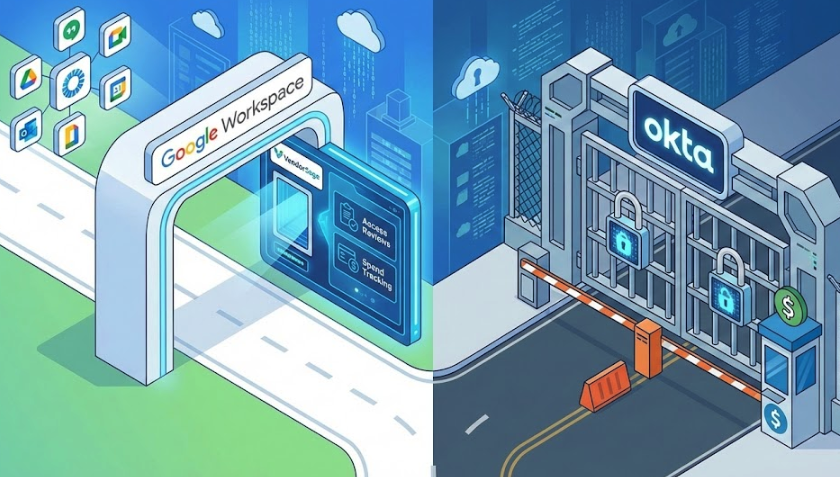
Google SSO vs Okta. By now you've checked out multiple reddit & blog posts
You're a 50-500 person company. You run your life on Google Workspace. But suddenly, you have 140+ SaaS applications in your environment. The spreadsheet IT uses to track who has access to what is hopelessly outdated. Finance is asking why software spend is up 30%, and your SOC 2 auditor is asking for proof that you offboarded that contractor last Tuesday.
The standard industry advice is to rip out your infrastructure and "upgrade to Okta."
But is it actually an upgrade? While Okta is the gold standard for massive enterprises, for a mid-market company, it often feels like buying a semi-truck to do a grocery run. It brings heavy implementation costs, technical debt, and the dreaded "SSO Tax."
There is a smarter way to handle scale. You can stick with the Google SSO you already love—if you pair it with the right governance layer.
If you are on Google Workspace, you already have a world-class authentication tool. It’s free, secure, and supports MFA (Multi-Factor Authentication).
The problem isn't logging in; the problem is lifecycle management.
Google Workspace is blind to what happens outside its ecosystem. It doesn't know that your marketing manager created a paid Miro account, or that your engineering lead is still logged into GitHub three days after they were fired.
The cracks show when:
The logical leap is to buy Okta to fix those governance holes. But for a company with 50–500 employees, the cure can be more painful than the disease.
This is the biggest shock for Finance teams. To use Okta’s automated provisioning (SCIM) and SAML, many SaaS vendors force you to upgrade to their "Enterprise" tier.
Take HubSpot as an example. You might be paying roughly $50/user for a standard Professional plan. To enable Okta SSO, you are often forced into the Enterprise tier, which can skyrocket the price to thousands of dollars a month.
When you multiply this across 50+ SaaS tools, your software spend doesn't just creep up—it doubles.
Okta is not plug-and-play. It requires technical configuration, maintenance, and often a dedicated IT administrator to manage API keys and broken integrations. If you don’t have a full-time IT Security Engineer, Okta often ends up as shelf-ware—paid for, but barely configured.
While it's possible to negotiate a 10% - 30% discount, it often requires a fair bit of volume (circa 300+ users).
Instead of abandoning Google SSO, the modern approach is to augment it.
VendorSage acts as the intelligence layer that sits on top of your existing Google Workspace. It handles the messy reality of "Who has access to what?" and "How much are we spending?" while leaving the simple login flow to Google.
This combination gives you a feature set that rivals Okta, but specifically designed for the mid-market.
By keeping Google as your front door and using VendorSage as the "SaaS Superintendent," you solve the governance problems without the infrastructure overhaul.
Google SSO handles turning off the email, but what about the 40 other apps the employee used?
Okta helps you log in, but it doesn’t help you save money. VendorSage connects directly with your ERP and Finance systems to spot wasted licenses.
If you are prepping for SOC 2 or ISO 27001, auditors want to see "User Access Reviews." They want proof that you checked who has admin rights to GitHub and Salesforce every quarter.
The landscape is changing fast. Here is what we are seeing in the market this year:
Stick with Okta.
If you have complex on-premise requirements, need to manage Active Directory forests, or have an unlimited budget for Enterprise SaaS tiers, Okta is a powerhouse. You will likely still need a Spend Management tool alongside it, but for pure identity in a massive org, Okta is the choice.
Stick with Google SSO + VendorSage.
If you have a lean IT team, primarily use SaaS tools, and want to keep costs down while nailing SOC 2 compliance, this is your winning stack. You avoid the implementation nightmare of a new IdP and save thousands in unnecessary "Enterprise" license upgrades.
You don't need to rip out Google Workspace to get enterprise-grade control. Let us show you how VendorSage can extend your current setup today.
[Get a Demo of VendorSage]
Can VendorSage replace Okta?
VendorSage doesn't replace the authentication (password) part of Okta—Google SSO does that for free. VendorSage replaces the need for Okta’s expensive Governance and Lifecycle modules.
Does VendorSage help with the "SSO Tax"?
Yes. Because VendorSage manages access and offboarding via workflows and finance integration rather than relying strictly on SAML/SCIM, you can often stay on the "Professional" or "Team" plans of your SaaS vendors rather than being forced to upgrade to "Enterprise" just for security control.
Is Google SSO secure enough on its own?
For authentication, yes—provided you enforce MFA. However, Google SSO is not sufficient for lifecycle management on its own because it leaves "Zombie Accounts" active in third-party apps after employees leave. That is the specific security gap VendorSage fills.
You are at a classic growth fork in the road...
[Get a Demo of VendorSage]